Start by listening without music
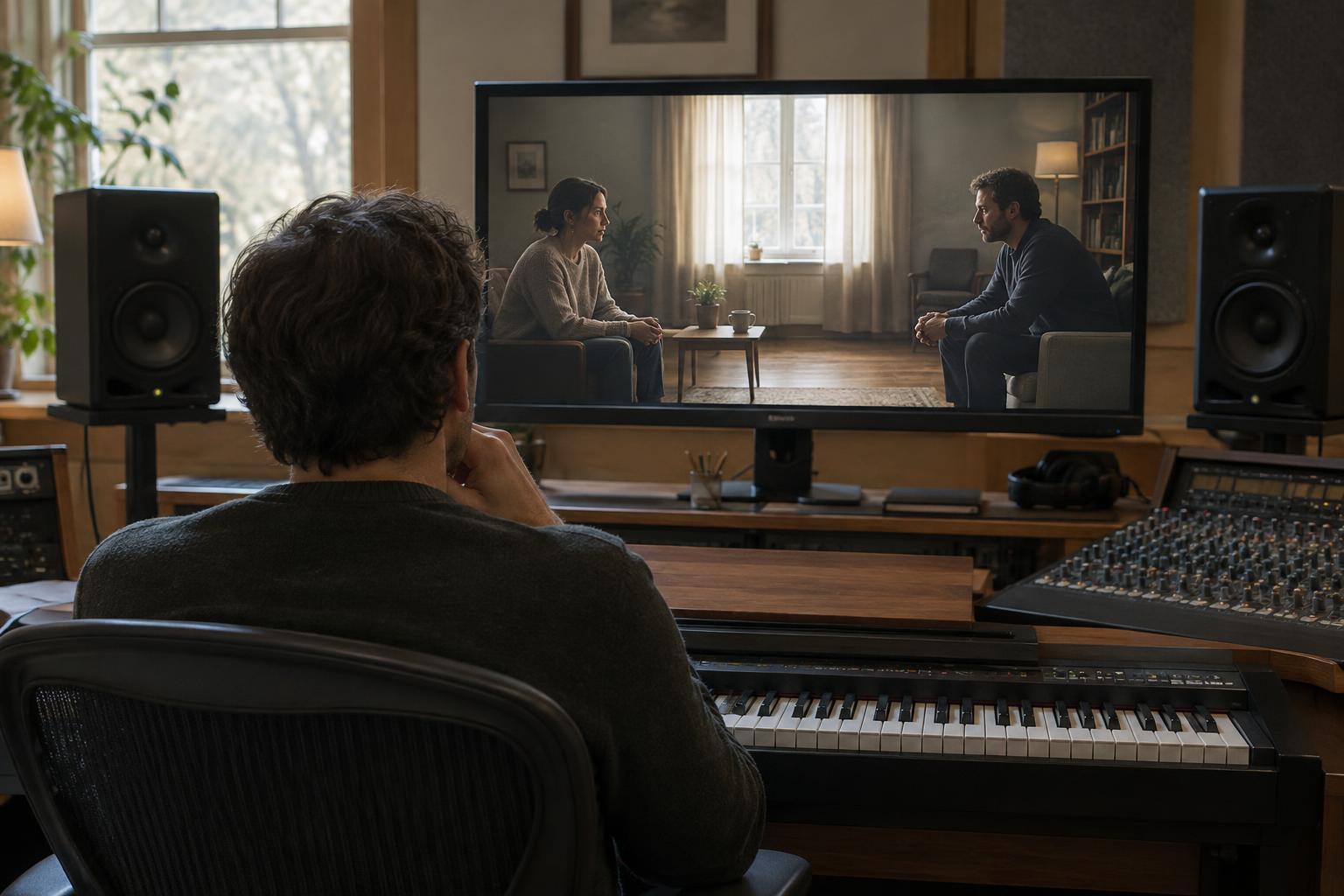
Before writing a cue, watch the scene with only its dialogue and production sound. Notice what the actors already communicate through pauses, breath, pace and changes in tone. A line that looks neutral on the page may feel tender, evasive or threatening in performance. The score should respond to what is on screen, not simply restate what the script says.
Ask what music could add that the scene does not already provide. It might connect a quiet exchange to an earlier moment, suggest a feeling a character is trying to conceal, or give shape to a gradual change in the conversation. If you cannot name its purpose, try leaving the scene unscored. Silence can keep attention on an uncomfortable pause or an unexpectedly honest reply.
Find the right moment to enter
A dialogue scene does not always need music from its first frame. An entrance after a revealing line can let the words land before the score offers a response. Music might begin when a character turns away, when the subject changes, or when the audience understands something one speaker does not. These are dramatic choices rather than fixed rules: the strongest entrance is the one that clarifies the scene without announcing itself too forcefully.
The exit matters just as much. A cue that fades before a difficult answer can leave that answer exposed. One that continues through the end of the exchange may carry its feeling into the next scene. When testing either choice, listen for whether the transition seems motivated by the story or merely by the end of a musical phrase.
Leave space for speech
Voices need room in the soundtrack. A busy melody, frequent accents or an instrument with a speech-like tone can compete with dialogue even when the music seems quiet on its own. Sparse notes, sustained textures or a simple pattern often make it easier to follow both the conversation and the cue. The aim is not to make every score restrained, but to choose complexity deliberately.
Pay attention to timing. An emphatic chord under a soft word may pull focus at precisely the wrong moment. Try placing musical changes between lines, beneath an action, or across a longer shift in the scene rather than matching every spoken beat. If a motif is important, it may be more effective as a brief hint during the exchange and a fuller statement after the characters stop talking.
Volume is only one part of making room. Register, rhythm and instrumental color also affect how music sits beside a voice. Test the cue with the actual dialogue whenever possible; a passage that sounds beautifully balanced alone may behave differently once speech and other scene sounds are present.
Choose a point of view without dictating a reaction
Music can appear to side with one character, reflect the distance between two people, or suggest a feeling neither person will admit. Decide whose experience guides the cue, then check whether that perspective helps the audience engage with the scene. A warm harmony under an apology, for example, might suggest sincerity when the performance leaves the question open. If that certainty weakens the moment, a less resolved sound or no music may serve it better.
Be especially careful when the scene contains a strong emotional turn. Scoring every revelation as a climax can make smaller gestures feel oversized. Holding back may give an actor's expression more weight, while a subtle change in texture can acknowledge the turn without prescribing exactly how viewers should feel.
Revise with the whole scene in mind
Create a few versions of the cue rather than treating the first approach as final. Compare an early entrance with a late one, a melodic version with a textural one, and a scored version with no music. Watch each in context instead of judging the composition by itself. The useful question is not which version sounds richest, but which makes the scene clearer and more compelling.
Finally, listen past the last line. Dialogue, room tone, movement and the next scene all affect how a cue feels. A small musical idea that leaves space for these sounds can do more storytelling than a continuous underscore. In a dialogue scene, making room is not a lack of ambition; it is part of the craft of scoring.