Choose a scene you can revisit
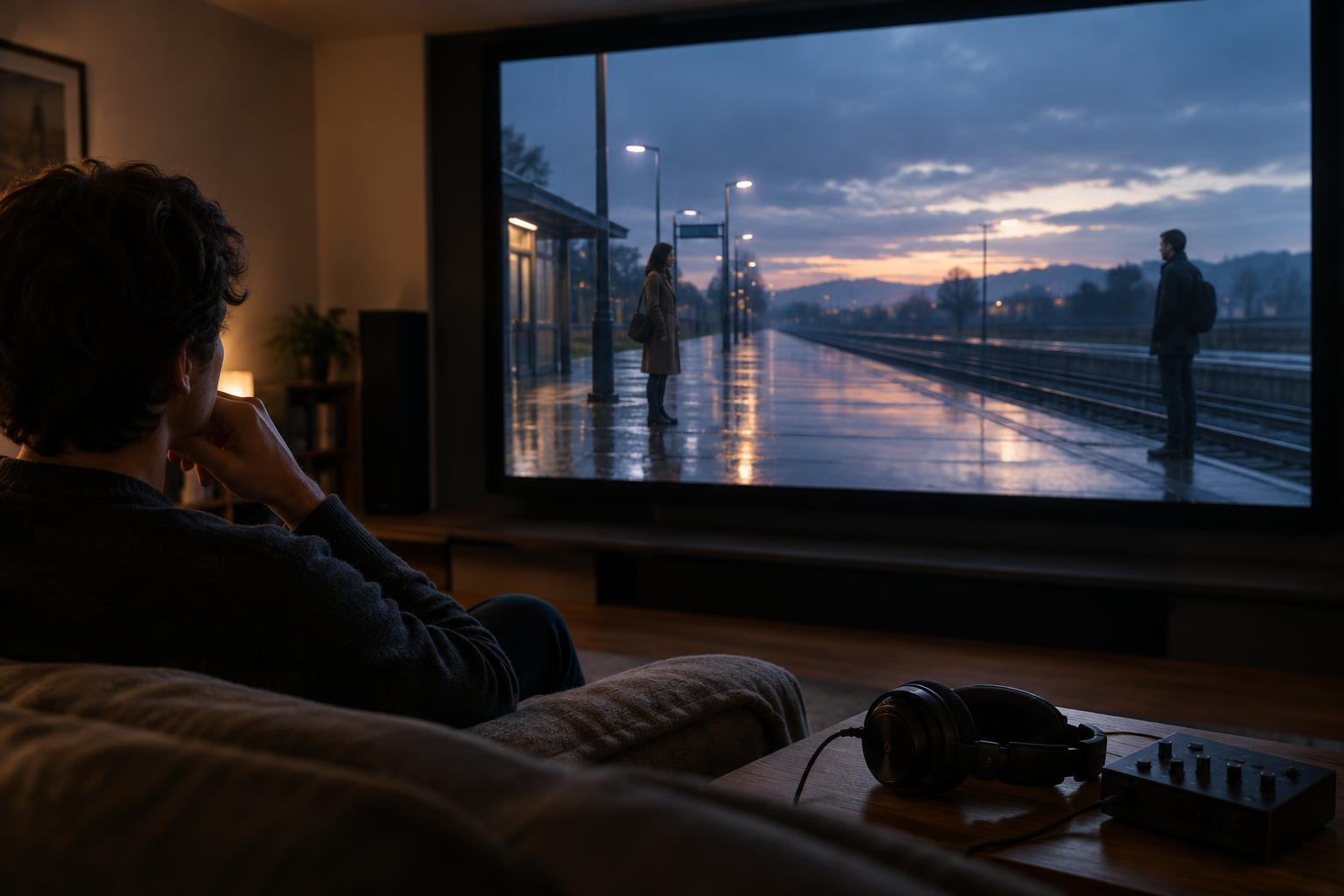
Pick a short scene—perhaps one or two minutes—with a clear beginning and end. A character entering a room, waiting for an answer or making a decision gives you plenty to observe without requiring you to track a complicated plot. Choose something you can replay easily and, ideally, a scene you have not studied closely before.
On your first viewing, leave the sound on and resist the urge to analyze every detail. Afterward, write down what you expected to happen, when that expectation changed and how the ending felt. Try words such as “uneasy,” “hopeful” or “unresolved,” but add a specific observation beside each one. Did a pause make you wait for bad news? Did a glance seem reassuring? This gives you a record to compare with later viewings.
Watch once for the scene, then listen for the score
Replay the scene with sound and direct your attention to the music. Notice where it enters and exits, whether it sits behind the dialogue or comes forward, and whether its pulse follows the action. Listen for changes in volume, register, texture and harmony. You do not need technical vocabulary: “a low sustained sound grows louder” is more useful than a label you are unsure about.
Ask what the music encourages you to anticipate. A repeated figure may make a quiet hallway feel like a countdown; a gentle melody may invite sympathy for someone whose expression is hard to read. Also notice moments when the score seems to disagree with the image. Calm music under frantic movement can create distance, humor or dread, depending on the rest of the scene. Describe the effect as a possibility, not a rule that every viewer must hear the same way.
Try a muted viewing—and understand its limits
Now mute the scene and watch it again. If subtitles are available, turn them on so you can follow the dialogue. Pay attention to performance, framing, movement, cuts and duration. Where do you look first? Which reaction shot tells you what matters? Does a pause still feel long? You may find that an emotion you attributed to the score was already present in an actor’s face or in the way the scene was edited.
Muting is not the same as removing only the music. It also takes away voices, room tone, footsteps and sound effects, all of which help shape the scene. Subtitles restore the words but not a speaker’s timing or tone. Unless you have access to a version with separate audio tracks, treat the muted viewing as a question-generating exercise rather than proof of what the score alone does.
Compare the moments where your reading changes
Return to the full soundtrack and focus on two or three precise moments. Perhaps a door opens just as the music stops, or a character smiles while a dissonant sound continues underneath. Compare what you noticed with the sound on and off. Did the music point your attention toward an object? Did it suggest that a safe-looking moment might not be safe? Or did dialogue and editing carry the main idea while the music added color?
It helps to separate observation from interpretation. “The music becomes louder before the cut” describes something you can check. “The music warns us about the next room” describes your reading of it. Both are valuable, but keeping them distinct makes it easier to discuss a scene with someone who heard it differently. A score can reinforce an obvious emotion, complicate it or simply help connect one moment to the next.
Use the exercise to hear the whole soundtrack
For a final viewing, listen beyond the music. A refrigerator hum, distant traffic or sudden absence of background sound can affect the scene’s atmosphere. Notice whether a sound seems to belong to the characters’ world, such as a radio playing in the room, or functions as part of the film’s broader score. When those layers blend, the boundary may be unclear—and noticing that uncertainty is part of attentive listening.
You can repeat the exercise with another scene from the same film or with two scenes that share a similar situation. The aim is not to decide whether a scene is better with or without music. It is to become more precise about how image, performance, editing and sound work together. Once you start listening for those relationships, even a brief scene can reveal several ways of telling its story.