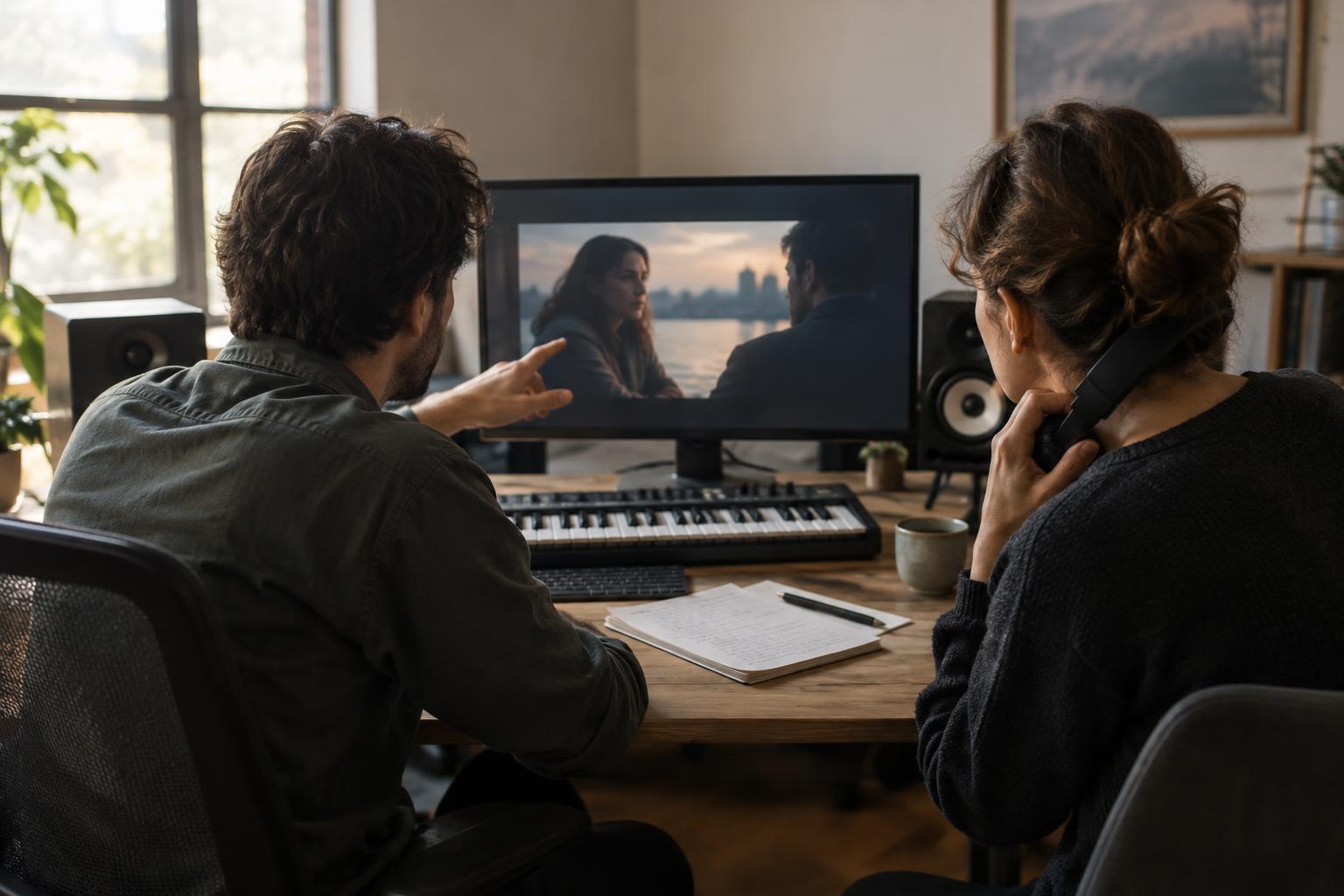
Start with what you hear and see
A low note enters as a character opens a door. Is it a warning, a sign of sadness, or simply a way to make the moment feel larger? Film music can support all of these readings, depending on what the image, dialogue and surrounding scenes contribute. Before deciding what a cue means, describe what it does. Note when it begins and ends, whether it grows louder or quieter, and what changes on screen while it plays.
A useful first pass separates observation from interpretation. “A sustained string sound continues under the conversation” is an observation; “the strings reveal that one character is lying” is an interpretation. Both can belong in an analysis, but keeping them distinct makes it easier to revisit your ideas. You may notice that the same sound accompanies an uneasy pause rather than a particular person, which opens up a different reading of the scene.
Listen for relationships, not musical translations
It is tempting to treat a musical feature as a word in a dictionary: minor chords mean sadness, fast rhythms mean danger, and a solo instrument means loneliness. Those associations can be useful starting points, but they are not rules. A quick pulse might convey excitement, panic or playful energy. A sparse melody might feel intimate in one scene and exposed in another. Performance, recording texture and the scene itself all affect how a cue comes across.
Ask how the music relates to the action. Does it follow a character’s movement, anticipate an event, or remain steady while the scene changes? Music that seems at odds with an image can be especially interesting. A gentle tune beneath a tense exchange might offer reassurance, recall an earlier moment, or sharpen the discomfort through contrast. Rather than choosing one answer immediately, identify which details support each possibility.
Track repetition and change across scenes
Repeated musical material gives you something to compare. If a melody returns, listen for differences in tempo, instrumentation, harmony and placement. A theme first heard in a full ensemble may later appear as a few quiet notes. That change may invite you to connect the scenes while noticing how the later moment feels different. It does not necessarily prove that the theme has one permanent meaning or belongs exclusively to one character.
Make a simple cue map as you watch: record the scene, the sound you recognize, and what is happening around it. Include instances when expected music does not return. These notes can reveal patterns that a single viewing might miss. They can also challenge an early assumption. If a familiar theme accompanies both a joyful reunion and a difficult farewell, it may be more helpful to discuss the relationship between those moments than to label the theme “happy” or “sad.”
Give silence and other sounds a place in the analysis
A score shares the soundtrack with voices, ambient sound and effects. The hum of a room or the rhythm of footsteps may carry attention through a scene without a conventional musical cue. When music drops out, the change can make a small sound newly prominent. Notice what fills the space: breathing, traffic, an object being handled, or near-quiet. Each can affect how you experience the next musical entrance.
Consider the boundaries of the cue, too. A sound may begin as part of the setting, such as music from a radio, then continue over a scene change in a way that feels like part of the score. Instead of forcing it into a single category, describe the shift and its effect. Does it connect two places, hold onto a character’s memory, or encourage you to hear a new scene through the mood of the last one?
Build an interpretation you can test
A strong reading does not need to claim certainty about a composer’s intention or an audience’s response. Try framing your idea as an invitation: “The delayed entrance of the melody makes the reveal feel hesitant.” Then test it against the cue. Would the same idea hold if the melody entered earlier? Does a similar delay occur elsewhere in the film? These questions turn a first impression into a closer account of how the scene works.
You can also try watching a scene with and without paying deliberate attention to the music. On one pass, follow the dialogue and action; on another, focus on entrances, pauses and changes in sound. Compare what you noticed rather than treating either pass as the correct one. The aim is not to remove ambiguity. It is to explain how particular choices make several meanings possible, and why one reading feels persuasive to you.