Start with attention, not equipment
A personal sound diary is a collection of listening moments. It might include short recordings, written descriptions, or both. Unlike a polished audio project, it does not need a theme or a perfect microphone. Its purpose is to help you notice what a place sounds like and what details you might otherwise forget.
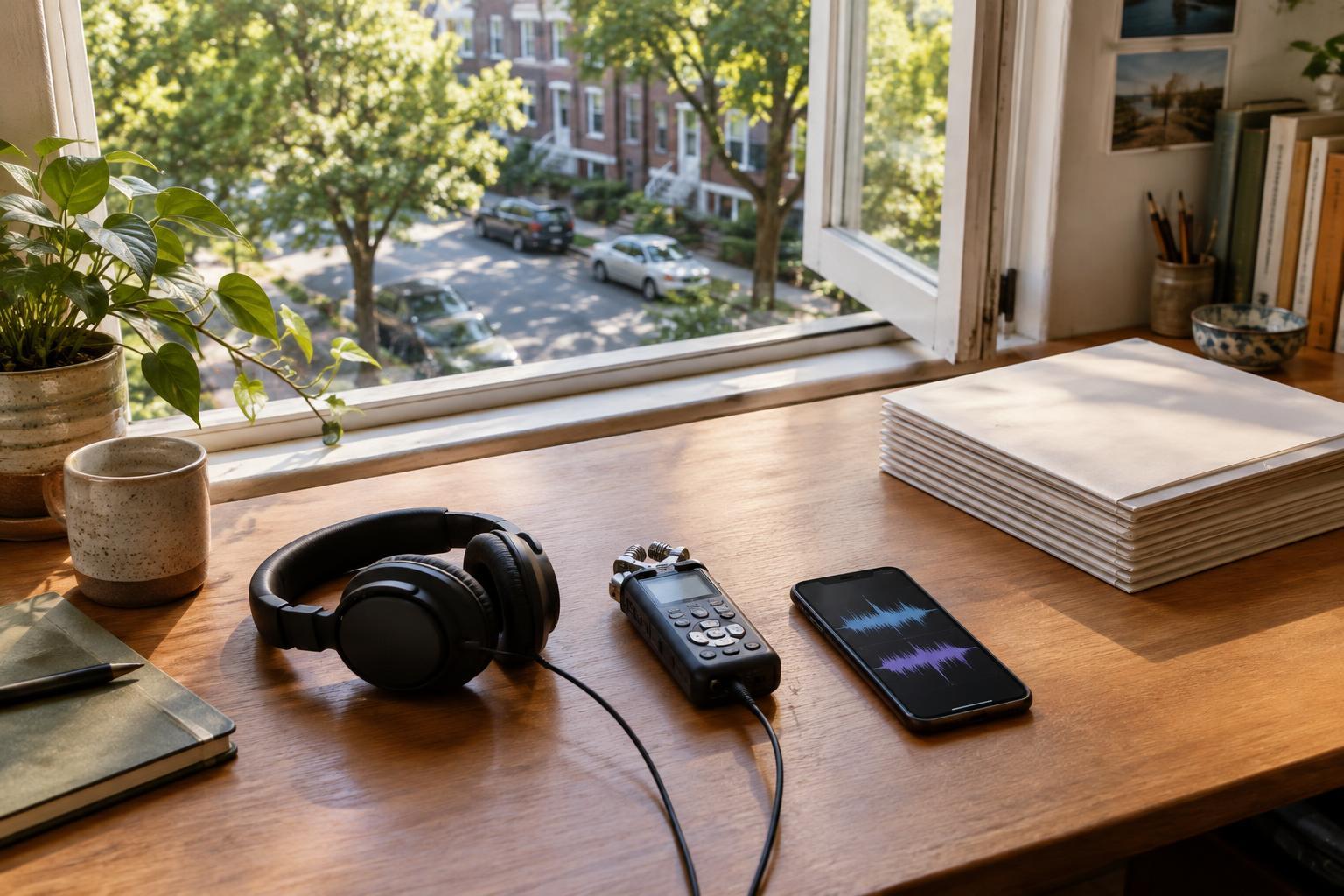
Begin with a small, repeatable plan. You could make one entry during a daily walk, listen for a few minutes from the same window each week, or record a sound that interrupts your routine. A phone and a notebook are enough. If recording is inconvenient, write the entry from memory soon afterward. The habit of paying attention matters more than the format.
Choose sounds with a sense of place
Look beyond sounds that are obviously musical. A gate closing, footsteps changing from pavement to gravel, water moving through a drain, or dishes being put away can each suggest a setting and an action. You might also notice layers: a nearby fan against distant traffic, or birdsong between bursts of conversation. A diary becomes more revealing when it includes both sounds you enjoy and sounds you usually ignore.
Try recording a brief stretch before deciding what the main subject is. A passing bicycle may be interesting, but the quieter seconds around it show how it entered and left the scene. If you return to the same place, capture it at different times and listen for what changes. Keep recordings short enough that you will want to revisit them.
Be considerate about what you capture. Avoid recording private conversations or identifying someone without their permission, and follow the rules of the place you are in. When recording feels intrusive, make a written listening note instead. You can describe the character of a busy room without preserving anyone’s words.
Describe the sound before interpreting it
For each entry, note where you were, roughly when you listened, and what was happening. Then describe what you can hear: Was the sound steady or irregular? Sharp or soft-edged? Close, distant, muffled, or echoing? Did it repeat, grow louder, fade, or stop abruptly? Comparisons can help, but try to name the audible detail behind them. Instead of only writing “the street sounded restless,” you might mention engines idling, quick footsteps, and a loose sign tapping in the wind.
After that, add your response. Perhaps the tapping reminded you of a rhythm, or the space between trains made the platform feel unusually still. Your reaction is part of a personal diary, but it need not stand in for everyone’s experience. Keeping observation and interpretation side by side lets you see how a sound can be both an event in a place and a prompt for memory or imagination.
Make entries easy to revisit
A simple entry can have four parts: a title, a brief context note, a description of the sound, and one question or impression. A title such as “Kitchen after breakfast” is more useful than a file name alone. If you have audio, label it to match the written entry. You can add a quick sketch of where sounds came from, especially if several sources were audible at once.
Do not feel obliged to edit every recording. Leaving a little silence or background noise can preserve the shape of the moment. If you do trim a file, keep a note of what you changed. For a diary without audio, write down a sound in your own words, even if the spelling feels awkward. “Two light clicks, a pause, then a heavier clack” may bring a moment back more clearly than a polished sentence.
Listen back for patterns and possibilities
After several entries, revisit them without trying to rank them. Notice which sounds recur, which ones mark a transition in your day, and which descriptions still help you imagine the scene. You may discover that you pay particular attention to entrances, fading sounds, or the contrast between mechanical and natural textures. Those patterns can guide your next recording or simply give you a richer sense of familiar places.
A sound diary can also become raw material for creative work. A repeated door latch might suggest a rhythm; the changing atmosphere of a stairwell might suggest a setting for a story. You do not have to turn the diary into a finished piece, though. Its value can be as straightforward as this: it gives ordinary sounds a little room to be heard.