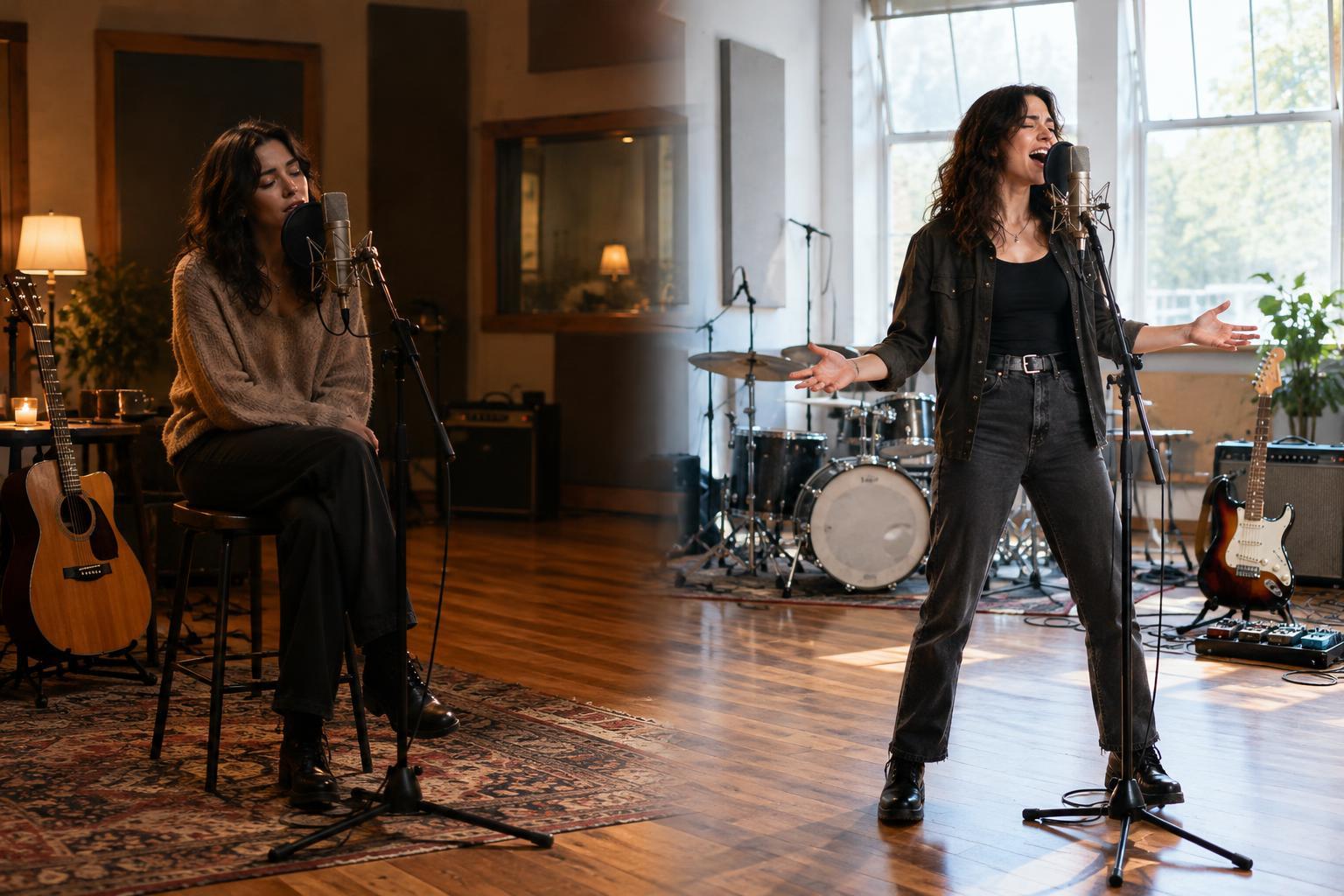
The song stays; the point of view shifts
Play two performances of a familiar song back to back, and you may find that one sounds like a confession while the other sounds like a declaration. The lyrics and central melody may be recognizable in both, yet the performers make different choices about where to linger, where to push forward and what to leave unsaid. Comparing versions is a way to hear a song’s possibilities, not a contest to decide which artist understood it correctly.
Begin with your first impression, then get specific. Instead of stopping at “this one is sadder,” ask what gave you that impression. Does the singer pause before a key word? Does a drum entrance make the chorus feel more determined? Your response is personal, but the audible details give you something concrete to discuss with another listener.
Tempo and phrasing change the story
Tempo shapes how much room a thought seems to have. A slower performance may give each line time to settle, drawing attention to hesitation or reflection. A quicker one can make the same words feel restless, playful or urgent. Speed alone does not dictate emotion: a slow, steady pulse can sound reassuring, while a brisk performance can sound strained if the singer seems to be racing the beat.
Listen next to phrasing—the placement and length of notes within that pulse. A performer might sing a line smoothly, connecting its words into a single thought. Another might break it with breaths or emphasize an unexpected syllable. Try listening to one verse twice, once for the meaning of the words and once for the way they are delivered. Notice whether the performance seems to ask a question, make a promise or resist saying either.
Dynamics and timbre bring different details forward
Dynamics are changes in loudness and intensity, not just a choice between soft and loud. A restrained opening can make a later swell feel earned; a forceful first line can make the song sound as though it begins in the middle of an argument. Pay attention to where each performer holds back. That moment may be as expressive as a climactic note.
Timbre, the character of a sound, also affects how a performance comes across. A breathy vocal, a bright piano and a rough-edged guitar can suggest different kinds of closeness or energy. These qualities are not fixed emotional labels: a rough voice need not mean anger, and a soft voice need not mean vulnerability. Hear how the sound works alongside the words, harmony and rhythm rather than assigning it a meaning on its own.
The arrangement decides what surrounds the song
Instrumentation can redirect your attention without changing a lyric. A lone voice and instrument may expose small timing choices, while a full band can turn a private-sounding line into something communal. Background vocals might answer the lead singer, support it or create tension with it. Even a repeated figure—a bass line, a drum pattern, a few piano notes—can change how you anticipate the next phrase.
Consider what each version removes as well as what it adds. If the rhythm section drops out before the final chorus, the return of the beat may feel like a release. If an arrangement stays sparse throughout, a single new harmony can become the main event. Neither approach is inherently more emotional. Each frames the song differently and invites you to follow different details.
Compare deliberately, then trust your own response
For a focused comparison, choose the same short passage in both performances. Listen first for the pulse, then for the lead voice or instrument, and finally for everything around it. Write down two or three observations before choosing adjectives for the mood. “The second singer waits longer before the last line” is more useful than “the second version has more feeling,” because it helps explain what you heard.
Recording space matters, too. A close, dry sound can make quiet gestures easy to notice; a roomy sound may give notes a longer afterlife. If one version is much louder than the other, adjust playback volume before comparing, since loudness can distract from subtler choices. In the end, your preference may change with your setting or your attention. The reward is hearing the song not as a single fixed message, but as material performers can shape into different experiences.