Start with what the song needs
A drum groove gives listeners a sense of where the beat is and how it moves. It can make a song feel steady, restless, spacious, or busy, even when the notes and tempo stay the same. Before placing any drum hits, listen to the melody and accompaniment. Where do phrases begin? Which words or chords deserve emphasis? Is there a moment that would feel stronger with a little space?
You do not need a complicated pattern to answer those questions. Try looping a short section of the song and tapping along. Notice the beat you naturally return to. That pulse is a useful starting point, not a rule you must follow. The goal is to build a part that supports the song rather than a pattern that calls attention to itself at every moment.
Use the kick to give the groove its footing
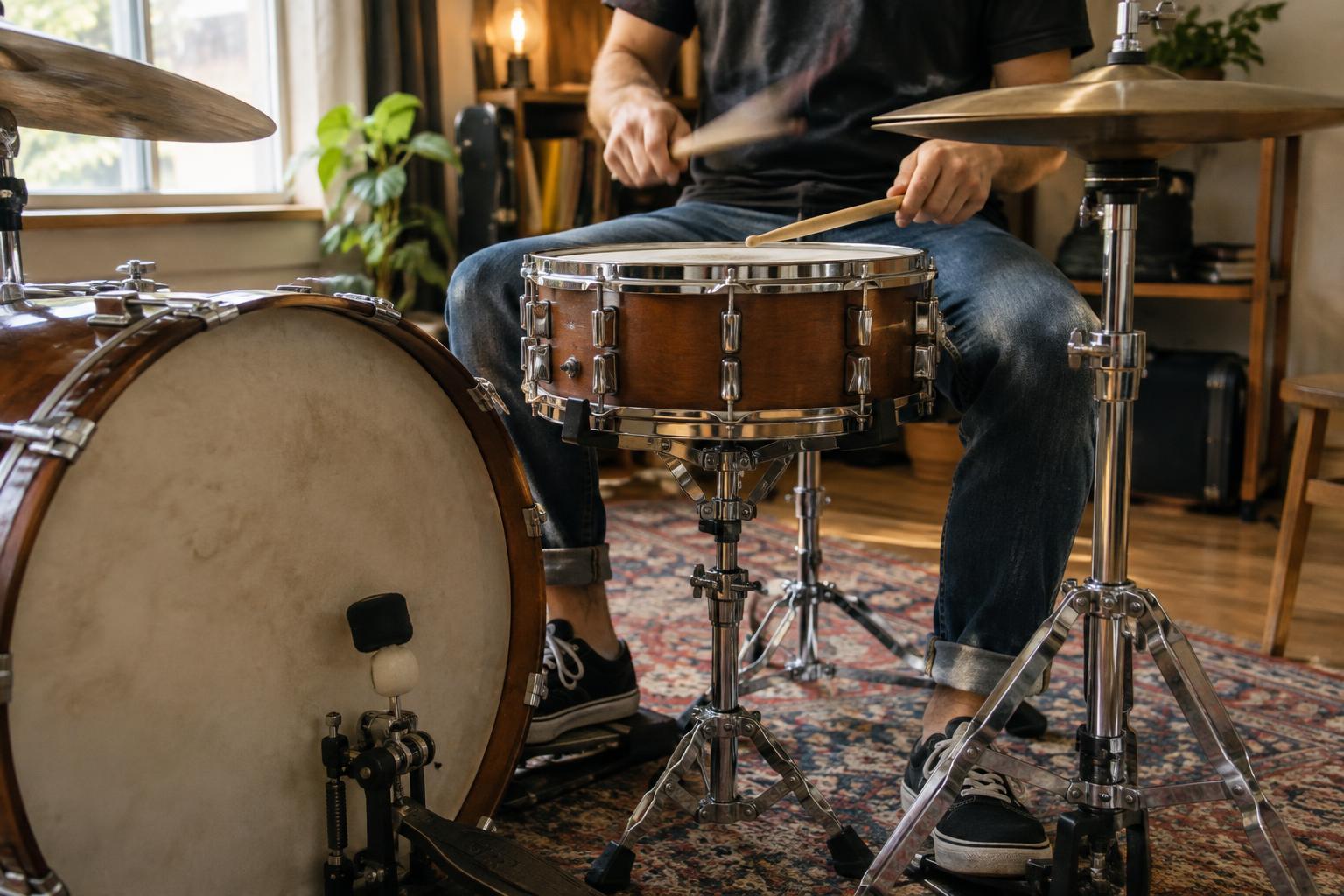
The kick drum supplies a low, short impact that can help establish the main pulse. In a simple four-beat bar, placing it on beats one and three gives many songs a clear foundation. Placing it on every beat creates a more continuous drive. Neither choice is automatically better: listen to how the kick sits beside the bass line and the accents in the other instruments.
Once the basic pulse feels secure, try moving or adding one kick hit. A hit just before a strong beat can pull the listener forward; one between beats can add motion without changing the tempo. Make one change at a time and compare the result with the simpler version. If the kick and bass compete for attention, try fewer hits or place them where their rhythms reinforce each other.
Let the snare mark the shape of the bar
The snare often provides the contrasting accent that makes a groove easy to follow. In a common four-beat pattern, snare hits on beats two and four create a familiar backbeat against a kick on one and three. Play that combination first, even if you expect to change it. It gives you a clear reference for hearing what each adjustment does.
A quieter snare hit between main accents can add texture, while leaving out an expected hit can make the next one feel more important. Use these options with the vocal or lead instrument in mind. A fill of snare notes may sound exciting by itself but crowd a lyric or melodic phrase. Sometimes a single well-placed accent gives the phrase more room to land.
Use the hi-hat to control movement and space
The hi-hat can divide the time between kick and snare hits. Playing it on each beat leaves gaps and often feels open. Playing twice per beat creates a more continuous surface. If that feels too busy, remove a few hits rather than changing everything else. A small gap before a snare accent can make that accent stand out.
The sound of each hi-hat hit matters as much as its position. Keep some hits light and let others mark the pulse. If you are playing or programming a pattern, avoid making every strike identical unless a deliberately rigid sound suits the song. An occasional open hi-hat can help signal a transition, but it has a longer, brighter sound that may cover other details. Listen to it in the full arrangement, not only in the drum loop.
Build a loop, then make it serve the arrangement
For a first pass, choose a short section and make a one-bar loop: kick on one and three, snare on two and four, and a light hi-hat twice per beat. Play it under the song. If the section needs more momentum, experiment with one extra kick or a denser hi-hat pattern. If it needs space, remove a hit. Keep returning to the original loop so you can hear whether each change helps.
Next, try the groove across a verse and chorus. They may not need entirely different patterns. A slightly more active kick, a firmer snare, or fewer hi-hat gaps might make the chorus feel distinct while preserving the song’s rhythmic identity. Think about transitions, too: a brief pause before a new section can be as effective as a fill.
Finally, listen without watching a drum grid or concentrating on your hands. Can you follow the song’s pulse? Do the accents support the phrases you wanted to highlight? If the answer is yes, the groove is doing its job. Save the more elaborate ideas for places where they add something the song is missing.